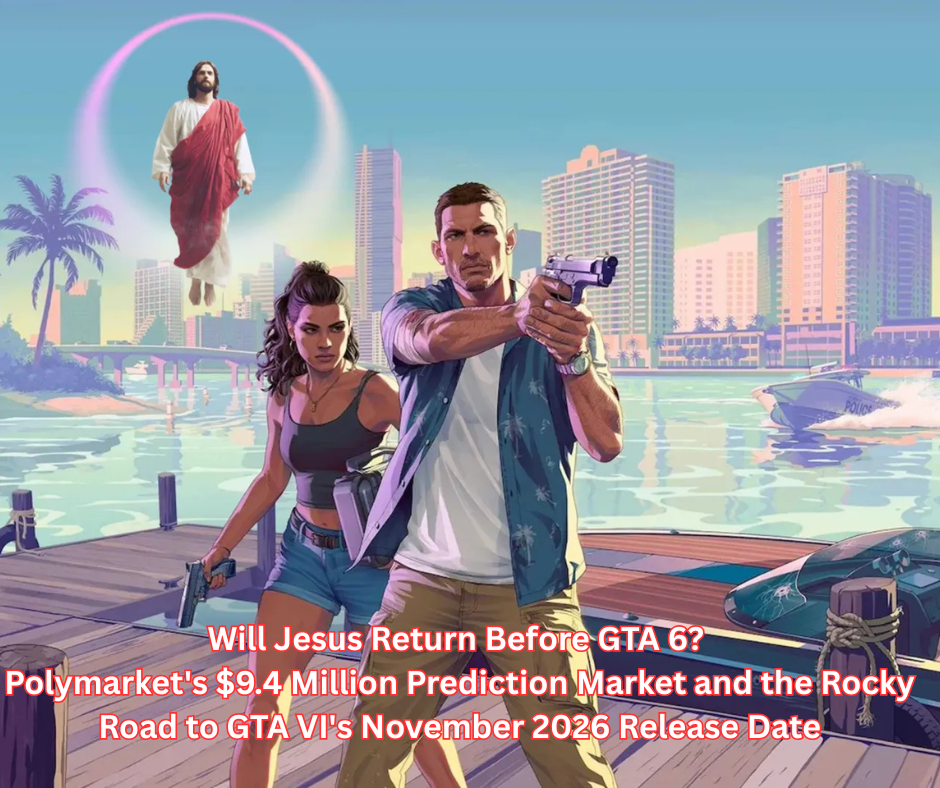
In the ever-evolving intersection of video game culture, cryptocurrency, and online speculation, few topics have captured the internet’s attention quite like the Polymarket wager: “Will Jesus Christ return before GTA 6?” As of February 2026, this seemingly absurd binary market has attracted over $9.4 million in trading volume within the broader “$17.4 million ‘What Will Happen Before GTA VI?’ event,” with the “Jesus Christ returns” outcome hovering near 49 cents for “Yes” shares. For gamers anxiously awaiting Rockstar Games’ long-delayed masterpiece, Grand Theft Auto VI (GTA VI), this prediction market serves as both meme fodder and a curious barometer of public sentiment surrounding the GTA 6 release date.
This article delves deeply into the phenomenon, examining the mechanics of Polymarket’s high-stakes betting pool, the protracted development saga of GTA VI, the cultural and economic implications of blending eschatological speculation with open-world gaming hype, and the broader rise of prediction markets in the gaming ecosystem. We explore the topic from multiple angles—including industry delays, arbitrage opportunities, meme culture, and resolution nuances—while providing context, historical parallels, edge cases, and forward-looking considerations for U.S.-based gamers, investors, and observers.
Understanding Polymarket: The World’s Largest Prediction Market Platform
Polymarket, launched in 2020 and now operating as the premier decentralized prediction market platform (with a regulated U.S. arm via QCX LLC), allows participants to trade event-based contracts using USDC cryptocurrency. Unlike traditional sportsbooks, Polymarket operates on blockchain principles where share prices directly reflect crowd-sourced probabilities: a 49-cent “Yes” share implies a roughly 49% market-implied chance of the event occurring.
The platform gained mainstream traction during the 2024 U.S. presidential election cycle, accurately forecasting outcomes with higher precision than many polls. By 2026, it has expanded into pop culture, geopolitics, crypto milestones, and—crucially—entertainment releases. Markets resolve based on predefined rules, often drawing from reputable news sources, official announcements, or community-vetted criteria. Traders profit (or lose) by buying low and selling high before resolution, with the platform handling billions in cumulative volume.
In the gaming sphere, Polymarket has become a go-to for betting on release dates, pricing models, and even sequel announcements. Keywords like “Polymarket GTA 6,” “GTA VI prediction market,” and “Rockstar Games betting odds” now trend alongside traditional gaming searches, reflecting how crypto-savvy gamers in the United States and globally are monetizing their knowledge (or hunches) about titles like Grand Theft Auto VI.
GTA VI: A Brief History of Hype, Delays, and Unparalleled Expectations
Rockstar Games’ Grand Theft Auto series has defined open-world gaming since the early 2000s. GTA V (2013) remains one of the best-selling entertainment products of all time, generating over $8 billion in revenue, while its online mode, GTA Online, continues to thrive nearly 13 years later. The announcement of GTA VI in December 2023—accompanied by a cinematic trailer showcasing a sun-drenched, Vice City-inspired Leonida (a satirical take on Florida)—ignited unprecedented anticipation.
The first trailer alone amassed hundreds of millions of views, highlighting protagonists Lucia and Jason (a criminal couple evoking Bonnie and Clyde vibes), expansive environments blending neon-lit cities, swamps, and beaches, and signature Rockstar satire on American culture. A second trailer in 2025 further teased gameplay elements: dynamic weather, advanced AI crowds, and what appears to be the largest map in series history.
However, Rockstar’s commitment to “the level of polish you have come to expect” has led to multiple delays. Originally eyed for Fall 2025, the GTA 6 release date shifted to May 26, 2026, and then again to November 19, 2026, for PlayStation 5 and Xbox Series X|S (with PC versions expected 1–2 years later, per historical precedent with GTA V and Red Dead Redemption 2). Take-Two Interactive’s CEO, Strauss Zelnick, reaffirmed in early 2026 earnings calls that the November 19, 2026, window remains firm, with marketing ramping up in summer 2026. Delays have cost the company tens of millions monthly in opportunity costs but are viewed as strategic for a title projected to eclipse $2 billion in opening-weekend sales.
These postponements are not anomalies for Rockstar. Red Dead Redemption 2 (2018) underwent significant crunch and delays for its cinematic quality, and GTA V itself launched after years of rumors. For U.S. gamers, this fuels a mix of frustration and understanding: AAA development in 2026 involves thousands of staff, cutting-edge engines (RAGE), and expectations for next-gen fidelity that no other studio matches.
The Polymarket “Jesus Return Before GTA 6” Market: Rules, Odds, Volume, and the Arbitrage Angle
The specific market falls under the umbrella event “What Will Happen Before GTA VI?” (total volume $17.4 million as of mid-February 2026). The “Jesus Christ returns” outcome—framed as the Second Coming—carries $9.4 million in isolated volume, making it one of the platform’s most heavily traded pop-culture contracts.
Key Rules and Resolution Criteria (per Polymarket documentation):
- Resolves “Yes” if credible evidence of the Second Coming of Jesus Christ occurs before GTA VI’s official U.S. release.
- Resolves “No” if GTA VI launches first.
- Critical nuance: If neither event occurs by July 31, 2026, at 11:59 PM ET, the market resolves 50/50 (shares pay out at 50 cents regardless of position).
With GTA VI firmly scheduled for November 19, 2026—well after the July cutoff—the market has become a near-arbitrage play. Bettors buying “Yes” at 49 cents or “No” at 53 cents anticipate a 50/50 resolution payout, yielding a small but low-risk edge (1–4 cents per share, scalable with volume). This explains the improbably high “Yes” probability despite the theological event’s low baseline odds in separate markets (e.g., “Jesus Christ returns before 2027” sits at just 3–4%).
Resolution sources remain opaque but typically rely on major news outlets or official ecclesiastical announcements for extraordinary claims. Edge cases include: What if a major religious figure declares a “return” that gains traction? Or if GTA VI faces yet another delay past November? Polymarket’s track record shows rigorous, community-monitored resolutions to maintain trust.
Other outcomes in the same event—Russia-Ukraine ceasefire (61% Yes), Bitcoin hitting $1 million (49% Yes), or a new Drake album—follow identical logic, turning the pool into a speculative dashboard on global events relative to Rockstar’s timeline.
Multiple Angles: Why This Market Resonates in Gaming Culture
Gamer Frustration and Meme Economy: U.S. gaming forums (Reddit’s r/GTA6, r/polymarket_bets) and platforms like X (formerly Twitter) and TikTok overflow with memes juxtaposing biblical imagery with Vice City heists. “Jesus gonna return before GTA 6” has become shorthand for AAA delay fatigue, echoing past waits for titles like Half-Life 3 or Elder Scrolls VI. The near-50/50 odds amplify the humor, reflecting collective skepticism toward Rockstar timelines despite official assurances.
Economic and Industry Implications: High volume signals deep engagement. For developers, such markets indirectly measure hype durability—sustained betting interest correlates with pre-order potential. Delays, while costly (estimated $10+ million monthly for GTA VI), prioritize quality, potentially boosting long-term revenue through reduced review bombing and stronger word-of-mouth. Prediction markets also offer studios indirect sentiment data, though Rockstar remains famously tight-lipped.
Cultural and Philosophical Nuances: The wager playfully collides sacred eschatology with secular entertainment. In a diverse U.S. audience, it sparks lighthearted debates without deep theological offense—most participants treat it as financial satire rather than prophecy. Related considerations include how internet culture normalizes blending faith, finance, and fandom. Broader implications: Prediction markets could evolve into tools for forecasting entertainment milestones, much like they do for elections.
Edge Cases and Related Considerations:
- Further GTA 6 delays (current Polymarket odds ~29% for another postponement) could shift resolutions favorably for certain positions.
- Marketing blitz starting summer 2026 may include new trailers, fueling ancillary markets (e.g., “Another GTA VI trailer by March 31?”).
- Crypto volatility affects accessibility—U.S. users benefit from regulated access, but global participants drive volume.
- Ethical angles: While harmless fun, large volumes on improbable events highlight speculation’s allure and risks.
Looking Ahead: GTA 6 Release Date Expectations and the Future of Gaming Bets
As November 19, 2026, approaches, focus shifts from biblical bets to gameplay reveals. Expectations include groundbreaking graphics, a dual-protagonist story with branching narratives, evolved GTA Online 2.0, and cultural touchstones rivaling past entries. Analysts project it as the largest entertainment launch ever, potentially revitalizing console sales and live-service models.
For prediction market enthusiasts, this episode underscores Polymarket’s maturation. Future markets may cover “GTA 7 announcement before 2030?” or micro-transaction controversies. Gamers in the United States can participate responsibly via the platform’s U.S.-compliant version, turning knowledge of Rockstar’s perfectionism into informed trades.
In conclusion, the “Will Jesus return before GTA 6” market—while driven largely by mechanical arbitrage and meme energy—encapsulates the passionate, patient, and playful spirit of modern gaming. Rockstar’s delays, though testing, promise a landmark title worthy of the wait. Whether your interest lies in the GTA 6 release date speculation, Polymarket strategies, or simply the cultural spectacle of Vice City versus the apocalypse, one thing is clear: the internet’s appetite for blending pixels and prophecy shows no signs of waning. Stay tuned, place bets wisely, and may the best outcome (digital or divine) prevail by late 2026.
This comprehensive analysis draws on official Rockstar announcements, real-time Polymarket data, and industry reporting to provide U.S. readers with a balanced, informative perspective on one of 2026’s most viral gaming stories.